

13396532368






Introduction
Silicon carbide (SiC) flat sheet ceramic membrane modules are commercially available in several filtering area configurations, with 7.5 m² and 6 m² being two of the most prominent sizes deployed in drinking water treatment. Both share the same fundamental SiC material advantages — hydrophilicity, chemical inertness, long service life, and absolute pathogen rejection — but differ meaningfully in capacity, flux ceiling, footprint efficiency, and suitability for different plant scales. The specifications referenced here draw primarily on CERAFILTEC SiC module data, representing industry-standard products.
Technical Specifications at a Glance
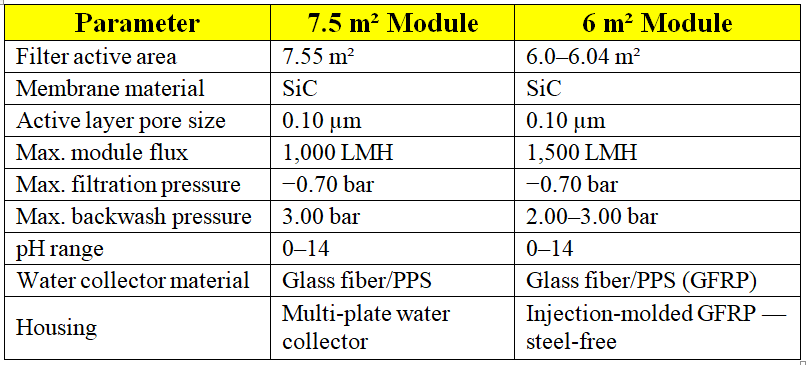
Both the 7.55 m² and 6.04 m² modules are constructed with an asymmetric
membrane structure with the active SiC filter layer coated on the outside, a pore size of 0.10 µm, Glass fiber/PPS water collector material, maximum filtration pressure of −0.70 bar, and maximum backwash pressure of 3.00 bar, with a full pH range of 0–14.
The key differentiating specification is the maximum module flux: the 7.55 m² module has a maximum module flux of 1,000 LMH, while the 6.0 m² module achieves a maximum module flux of 1,500 LMH.
Advantages of the 7.5 m² Module
1. Greater Membrane Area Per Module Unit
The most direct advantage is the 25% larger active filtering area per single module (7.55 m² vs. 6.04 m²). For a given target production volume, fewer modules are required with the 7.5 m² configuration. This translates into:
- Fewer module connections and permeate outlets to install and maintain
- Reduced number of individual membrane elements to track and replace over time
- Lower module count in large-scale installations, simplifying inventory management
2. Lower Capital Cost Per Square Meter of Membrane at Scale
Because more filtration area is packed into each physical module, the 7.5 m² format delivers a lower installed cost per unit of membrane area when purchasing and deploying at scale. For large municipal drinking water plants where hundreds or thousands of modules are specified, this per-unit efficiency becomes a meaningful capital cost advantage.
3. Reduced Number of Module Connections and Potential Leak Points
In submerged membrane systems, every permeate pipe connection, air scour fitting, and module-to-rack joint is a potential source of leakage or seal failure. Fewer modules of 7.5 m² versus more modules of 6 m² mean fewer such connections for the same installed membrane area, improving long-term reliability.
4. Better Suited for Large-Scale Drinking Water Plants
The 7.5 m² module format is the preferred choice for high-capacity municipal installations where maximizing membrane area density per tank is important. The additional area per module allows designers to achieve high daily production volumes within a fixed basin footprint with fewer module positions.
Advantages of the 6 m² Module
1. Significantly Higher Maximum Flux Rate
This is the single most important advantage of the 6 m² module. A pilot with a filter area of 6.0 m² was producing up to 170 m³/day from a single module — the first time a ceramic flat sheet membrane operated at flux rates of 1,000 LMH and well beyond. The transmembrane pressure remained very low at an average TMP of only −0.18 bar, allowing a significantly more compact system and resulting in tremendous savings in both CAPEX and OPEX.
At a maximum flux of 1,500 LMH versus 1,000 LMH, the 6 m² module operates at 50% higher flux intensity, which can entirely offset the smaller membrane area in applications where filtration cycles are short and feed water quality is favorable.
2. Steel-Free, Injection-Molded Housing
The use of NORYL™ glass-reinforced PPE resin in the CERAFILTEC 6.0 m² module achieved a seven-fold reduction in cost compared to the plastic-and-steel frame design, extended module life to up to 20 years (twice the lifetime of earlier steel-frame designs), and matched the expected lifespan of the ceramic membranes themselves. All process functions are integrated in the module, driving ease of assembly and operation. The elimination of stainless steel framing is a crucial practical benefit: it removes corrosion risk entirely, and enables the most compact, corrosion-free high-flux ultra filtration module on the market.
3. More Compact and Flexible Installation
The frameless design concept of the 6.0 m² module enables a multi-tower configuration that is the most compact and flexible installation option available, while sand filter capacity can be increased by up to 3× within the same footprint using ceramic membranes. The 6 m² module's fully molded GFRP housing also makes it lighter to handle and install than steel-framed alternatives, reducing civil and mechanical installation costs.
4. Individually Interchangeable Membrane Plates
The 6.0 m² module features a multi-ceramic-plate configuration with exchangeable single ceramic plates, internal filtered water piping, and module housing fully made of glass fiber reinforced resin — free of any steel parts. Individual plate exchangeability means that a single damaged or fouled plate can be replaced without taking the entire module out of service, minimizing downtime and reducing maintenance cost to the minimum necessary.
5. Higher Operational Flexibility and Resilience
The higher peak flux of the 6 m² module (up to 1,500 LMH) gives plant operators a larger operational buffer. During peak demand events, storm-event turbidity spikes, or partial module downtime, the 6 m² modules can be pushed harder to maintain treatment capacity without requiring additional modules to be brought online.
6. Proven in Hot-Water and Harsh Feed Water Applications
The 6 m² CERAFILTEC module is offered in an extended-temperature version for hot-water applications, in addition to the standard cold-water version, enabling the module to work in a broader range of conditions. This versatility makes the 6 m² module suitable not only for conventional drinking water treatment but also for hot-process water treatment and demanding industrial feed waters.
Head-to-Head Summary
Conclusion
Both module sizes share the core SiC advantages that make them superior to polymeric and conventional ceramic oxide membranes: permanent hydrophilicity, absolute pathogen rejection, full pH tolerance, long service life, and resistance to aggressive cleaning. The choice between them is primarily one of design priority:
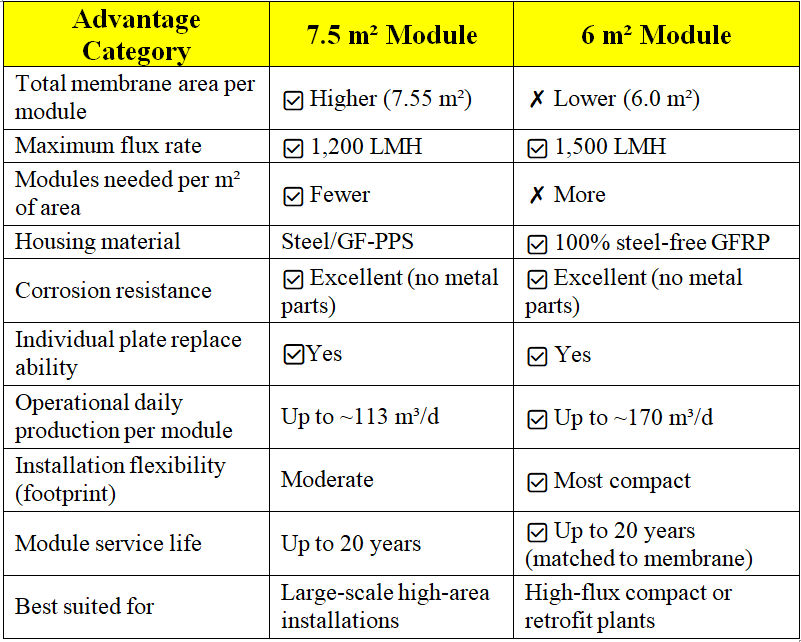
- The 7.5 m² module is the stronger choice when the design objective is maximizing membrane area per module position, minimizing module count in large installations, and achieving the lowest cost per m² of installed area.Also can stand 20 years lifespan. JMcleantec's 7.5㎡ module plates quality is one of the best currently in the world.
- The 6 m² module offers the superior operational package for most drinking water treatment scenarios: a significantly higher peak flux (1,500 LMH), a fully steel-free and corrosion-proof housing with a 20-year lifespan, individual plate replace ability, and a more compact and flexible installation footprint — particularly valuable for sand filter retrofits and capacity expansions where civil works must be minimized.
For Greenfield large-scale plants with ample space, the 7.5 m² module delivers capacity efficiency. For retrofit, compact, or high-throughput applications, the 6 m² module's flux performance and engineering design innovations give it the broader practical advantage.
Technical data sourced from CERAFILTEC product specifications, ceramic-flat-membrane.com module database, SABIC/CERAFILTEC application notes, and AWA Water e-Journal pilot plant reports.