

18072885002

CONTACT US
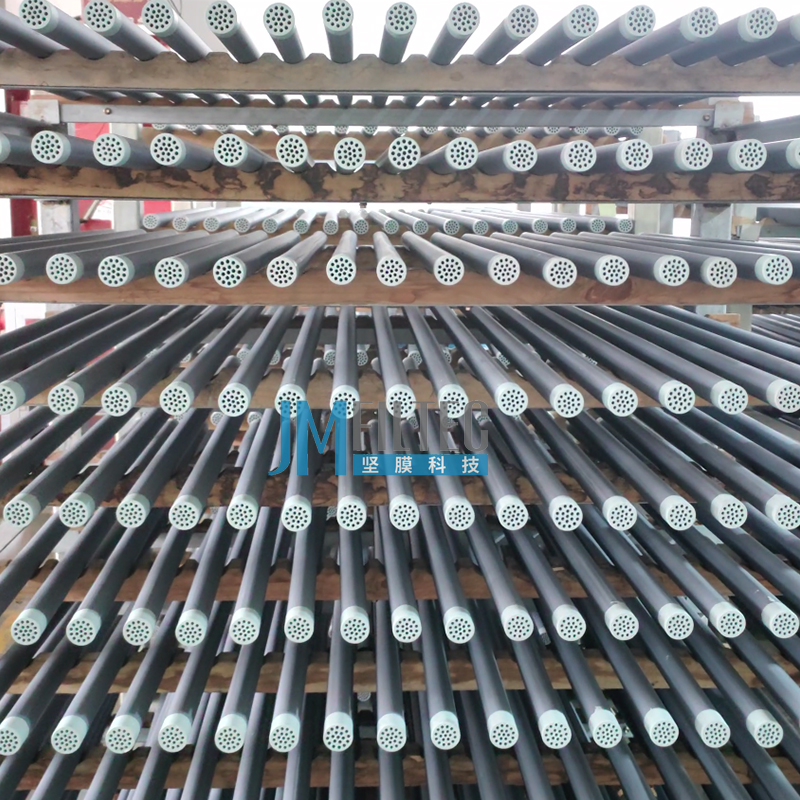
1. A view of specialty of this tubular membrane
|
>99.5% |
99.4% |
|
SiC purity (recrystallisation grade) |
Suspended solids removal rate 55.6% Open porosity (optimised 2025) |
|
54.9 MPa |
>99.9% |
|
Flexural strength (latest research) 40 nm Achievable UF pore size (2026) |
Oil rejection in UF configuration
|
2. Asymmetric tubular structure — 3 layers
a. Macroporous support
Coarse α-SiC particles (~7–15 µm); provides mechanical strength; avg. pore size ~15 µm; porosity ~40%. Carries the whole membrane assembly.
b. Transition layer
Intermediate SiC particle size; bridges pore size gap between support and selective layer; prevents selective layer from cracking.
c. Selective (active) layer
Nano-scale SiC particles (≥100 nm); defines filtration accuracy (MF/UF); average pore size down to 60 nm; defect-free when spin-coated at 1300 °C.
3. Key material properties
a. Chemical resistance
Stable across full pH 0–14 range. Withstands concentrated acid, alkali, and oxidising agents (including ozone). No degradation from chlorine-based cleaning.
b. Surface charge
Strong negative zeta potential across wide pH range — naturally repels negatively charged foulants (oil emulsions, proteins, bacteria) and reduces irreversible fouling.
c. Hydrophilicity
Inherently hydrophilic outer surface — water is preferentially drawn through the membrane over oils
and organics. Surface roughness (and thus hydrophilicity) increases with sintering temperature.
d. Thermal stability
Operating temperature up to 800–1000 °C. Handles high-temperature produced water and industrial streams without structural changes.
e. Filtration mode
Cross-flow filtration: feed flows at high speed inside the membrane tube (tangential to the membrane surface); permeate exits perpendicular through the wall. This self-sweeps the surface and minimises fouling.
f. Multi-channel geometry
Typical commercial tubes: 25 mm diameter, 305 mm length, 30 internal channels of 3 mm each — compact design maximises surface area per unit volume for bulk processing.
4. Here is what makes SiC tubular ceramic membranes stand out from all other membrane materials:
4.1 What it is and how it's made
The SiC ceramic tubular membrane uses recrystallisation technology through high-temperature sintering, where the porous support layer, transition layer, and film layer are all made from high-purity silicon carbide (>99.5%) without adding any sintering additives — inheriting virtually all the desirable characteristics of silicon carbide as a material.
The triple-layer asymmetric structure is what makes it so effective. A SiC ultrafiltration membrane with a triple-layer asymmetric structure uses micro-scale SiC particles for the substrate and nano-scale SiC particles for the selective layer, achieving an average pore size of 60 nm when sintered at 1300 °C, with defect-free selective layers successfully coated on the high-purity SiC substrate by spin coating.
4.2 Why the surface chemistry is exceptional?
Compared with conventional oxide ceramic membranes such as Al₂O₃, SiC membranes offer higher porosity, stronger hydrophilicity, and a unique negative surface charge that delivers higher flux and superior separation efficiency — and their strong chemical resistance allows stable long-term operation under strong alkaline environments and aggressive acid cleaning conditions.
4.3 Outstanding filtration performance
Pure SiC membranes evaluated on real secondary effluent from a wastewater treatment plant demonstrated high removal of suspended solids (99.4%) and colloidal particles (96%), along with significant reduction of chemical oxygen demand (83%). For oily water specifically, oil rejection of the SiC UF membrane exceeded 99.9%, providing a new possibility to treat corrosive and oily wastewaters.
The latest breakthrough in porosity vs. strength balance
With pore-forming agent dosage optimised to 15%, recent 2025 research achieved a high open porosity of 55.6%, enhanced permeability, and improved mechanical strength of 54.9 MPa — demonstrating the membrane's potential for effective water treatment applications.