

18072885002






Introduction
Ceramic membranes have become a preferred technology for water and wastewater treatment thanks to their mechanical strength, chemical resistance, thermal stability, and long service life compared to polymeric membranes. But like any membrane process, ceramic membranes suffer from a persistent problem: fouling, especially by dissolved and macromolecular organic matter such as humic acids, proteins, and natural organic matter (NOM). Fouling reduces permeate flux, raises energy costs, and shortens membrane life.
One of the more promising solutions to emerge in recent years is pairing ceramic membranes with nanobubble (and micro-nanobubble, MNB) generators. This combination is being used both to prevent fouling during filtration and to clean membranes that are already fouled — and in some configurations, to actively degrade organic pollutants in the feedwater itself.
What Are Nanobubbles?
Nanobubbles are gas bubbles roughly 100–200 nanometers to a few micrometers in diameter — far smaller than the bubbles produced by conventional aeration. Because of their size, they behave very differently from ordinary bubbles:
● They don't rise quickly and pop. Nanobubbles have near-neutral buoyancy and can remain suspended in water for days or weeks rather than seconds.
● They carry a negative surface charge, which helps them adsorb onto and interact with organic foulants and particles suspended in water.
● When they collapse, they generate localized shear forces and, in some cases, reactive oxygen species (ROS) such as hydroxyl radicals (•OH), which can help break down organic molecules.
● They dramatically increase gas-to-liquid mass transfer efficiency, which matters a lot when the gas involved is a strong oxidant like ozone.
Nanobubble generators typically produce these bubbles using one of a few mechanisms: high-shear rotational/venturi devices, pressurized dissolved-gas release (similar to dissolved air flotation), or ultrasonic cavitation. The gas used can be plain air/oxygen, or — for more aggressive treatment — ozone.
Why Combine Nanobubbles with Ceramic Membranes?
1. Fouling Prevention During Filtration
Micro and nanobubbles have demonstrated remarkable efficacy in preventing fouling and aiding membrane cleaning across diverse filtration techniques, and in crossflow filtration, the use of these bubbles restored ceramic membrane flux to 80% after backwashing. The bubbles are typically introduced into the feed stream or used during backwash cycles, where they help scour the membrane surface and disrupt the cake layer of organic foulants before it consolidates.
2. Enhanced Chemical-in-Place (CIP) Cleaning with Ozone
Perhaps the most researched application is combining ozone with nanobubble generation for CIP cleaning of ceramic membranes fouled by dissolved and macromolecular organics. Ozone micro-nano-bubble technology can effectively loosen the structure of the foulant layer on the membrane surface, reducing the adhesion of foulants, and the hydroxyl radicals produced through catalysis by the alumina in the ceramic membrane can achieve deep cleaning of the contaminated membrane. The nanobubbles provide the shear force needed to physically dislodge the foulant layer, while simultaneously achieving much higher ozone mass transfer efficiency than conventional bubble diffusion — meaning less ozone gas is wasted and more of it actually reacts with the foulant.
A related study built a novel ozone-nanobubble generator system to clean a fouled ceramic membrane typically used in the dye industry, and found that the surface characteristics of the membrane changed significantly, with reduced surface roughness and foulant accumulation as confirmed by atomic force microscopy, scanning electron microscopy, X-ray fluorescence, and energy-dispersive spectroscopy. Fourier-transform infrared (FTIR) spectroscopy of the residual foulant showed characteristic organic signatures — hydrogen-bonded groups and unsaturated carbon-carbon bonds — consistent with the ozone nanobubbles breaking down complex organic foulant molecules rather than simply dislodging them intact.
3. Air/Oxygen Nanobubbles as a Lower-Cost Alternative
Not every application requires ozone. Ghadimkhani et al. demonstrated the successful unclogging of ceramic membrane pores using air nanobubbles in both pilot- and bench-scale investigations, restoring permeate flux to its original values. In one experiment, humic acid fully clogged a ceramic membrane within 6 hours, reducing flux nearly to zero, but when the fouled membrane was fed with nanobubble water, the initial flux was restored within 2 hours — an effect attributed to the breakdown of organic matter by free radicals generated as the air nanobubbles collapsed. This suggests that even without a strong oxidant like ozone, the physical collapse of nanobubbles can generate enough localized reactive species to help degrade adsorbed organics.
Air nanobubbles are attractive because they avoid the capital and safety costs of on-site ozone generation, making them a more accessible option for smaller treatment plants or industries such as dairy processing, where nanobubbles have also been shown to improve flux and reduce filtration time.
4. Pretreatment for Downstream Membrane Processes
Ceramic membranes are also being used as a pretreatment step ahead of tighter membranes like nanofiltration (NF), and nanobubble/ozone-assisted approaches can improve how well that pretreatment works. In one study of drinking-water-plant production wastewater, a hybrid ceramic membrane–nanofiltration process achieved average removal rates of 95.60% for dissolved organic carbon, 98.55% for UV254 (a proxy for aromatic organic content), 34.50% for conductivity, and 50.71% for calcium — improvements of 4.70%, 1.40%, 16.37%, and 10.36% respectively over standalone nanofiltration. The ceramic membrane pretreatment also reduced irreversible fouling of the downstream NF membrane across a range of pollutant concentrations, and scanning electron microscopy confirmed that this pretreatment alleviated fouling on the NF membrane surface.
Separately, ozone-based surface flushing has been explored as a way to reduce the need for conventional microfiltration/ultrafiltration pretreatment ahead of ceramic nanofiltration membranes. Conventional pretreatment using multi-media filtration, microfiltration, or ultrafiltration before nanofiltration adds significant capital cost, physical footprint, and system complexity, so replacing filtration-based pretreatment with an ozone-based process is an appealing way to reduce cost and footprint, especially in urban water recycling settings.
5. Direct Organic Pollutant Degradation
Beyond membrane cleaning, micro-nanobubble systems are increasingly studied as an advanced oxidation-adjacent technology in their own right. In one wastewater treatment study, combining a hydrodynamic cavitation generator with an additional oxidation process raised total organic carbon removal efficiency to 40.01% over 90 minutes, compared to only 14.61% using the cavitation generator alone.This illustrates that nanobubble/cavitation systems often perform best as part of a hybrid process rather than as a standalone treatment.
How a Typical System Works
A combined nanobubble–ceramic membrane system generally includes:
● Gas supply — ambient air, oxygen, or ozone generated on-site.
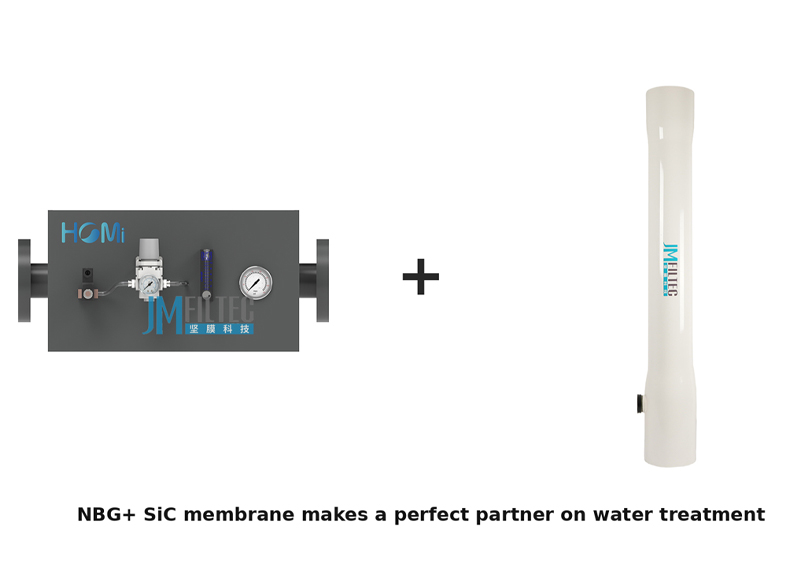
● Nanobubble generator — a venturi, shear-pump, or pressurized-dissolution unit that injects the gas into water as nanobubbles.
● Contact/reaction stage — nanobubble-enriched water is either fed continuously into the membrane feed stream, or used in periodic backwash/CIP cycles.
● Ceramic membrane module — typically alumina, zirconia, or titania-based tubular or flat-sheet elements, operated in crossflow or dead-end mode.
● Monitoring — flux and transmembrane pressure are tracked to determine when a nanobubble-assisted cleaning cycle is needed.
Advantages of the Combined Approach
● Higher flux recovery after cleaning, often without harsh chemical cleaning agents.
● Reduced chemical consumption — especially valuable where ozone nanobubbles replace or reduce the use of acid/caustic cleaning chemicals.
● Better mass transfer of oxidants, so less ozone or air is needed to achieve the same cleaning effect.
● Extended membrane lifespan due to gentler, more uniform cleaning compared to aggressive chemical or mechanical cleaning.
● Potential to shrink pretreatment footprint when used ahead of tighter membranes like NF or RO.
Limitations and Open Questions
Despite promising results, researchers note some gaps:
● The influence of bubble size and concentration on fouling control is not yet fully understood, and optimal operating parameters can be system- and foulant-specific.
● Ozone nanobubble systems require careful material compatibility checks, off-gas management, and safety controls given ozone's toxicity.
● Most published results come from bench- or pilot-scale studies; large-scale, long-term operational data are still limited.
● Performance depends heavily on the nature of the organic foulant (e.g., humic acids vs. proteins vs. synthetic dyes), so results don't always generalize across applications.
Conclusion
The pairing of nanobubble generators with ceramic membranes represents one of the more practical advances in fouling control for water and wastewater treatment. Whether used for fouling prevention during filtration, ozone-enhanced CIP cleaning, or as pretreatment ahead of nanofiltration, the technology leverages the unique physics of nanobubbles — long stability, high surface reactivity, and efficient gas transfer — to reduce chemical use, restore flux, and extend membrane service life. As the underlying mechanisms become better characterized, this combination is likely to see broader adoption across drinking water treatment, industrial wastewater treatment, and water reuse applications.