

13396532368






In the preceding text, we systematically described the fouling mechanism and differences of PAM on inorganic membranes. Among various industrial application scenarios, oil and gas field produced water (including polymer flooding produced water and fracturing flowback fluid) is the typical water quality with the most prominent PAM membrane fouling and the highest difficulty in treatment.
I. Native PAM: A unique source of contamination in oilfield settings
Unlike PAM used for water treatment flocculation, PAM is commonly used as an oil displacement agent, fracturing fluid additive, water shut-off agent, and drilling fluid conditioner, injected into produced water in oil fields. This type of PAM hydrolyzes and degrades under the high temperature and pressure of the formation, dispersing uniformly in the water in a dissolved state, thus interfering with the membrane system in two ways:
● Reduced front-end treatment efficiency: Hydrolyzed PAM disperses crude oil and suspended solids in water, making it more difficult for oil droplets and particles to be effectively separated by coagulation and sedimentation, indirectly increasing the fouling load of the membrane unit;
● This directly causes deep blockage: PAM molecules are on the same order of magnitude as membrane pore size, allowing them to penetrate conventional pretreatment units. Once inside the membrane channels, they become entangled and solidified, forming irreversible deep blockage. This is the core reason why, even when oil and turbidity meet standards, membrane flux continues to decline.
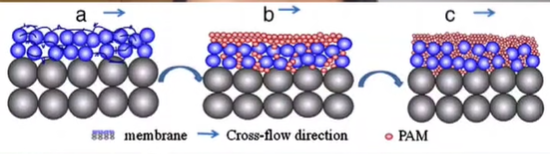
Figure - Schematic diagram of the microscopic mechanism by which PAM exacerbates membrane fouling
Source: "Application of ceramic membranes in the treatment of oilfield-produced water: Effects of polyacrylamide and inorganic salts"
Meanwhile, oilfield reinjection water generally has the characteristics of high hardness and high mineralization. Inorganic salt ions compress the hydration layer of PAM molecules, change the molecular chain conformation, making them easier to accumulate on the membrane surface and form a denser fouling layer; at the same time, the active groups of PAM complex calcium and magnesium ions, promoting the formation of organic-inorganic complex scale, significantly improving the stability of the fouling layer, and significantly reducing the effectiveness of conventional acid and alkali cleaning.
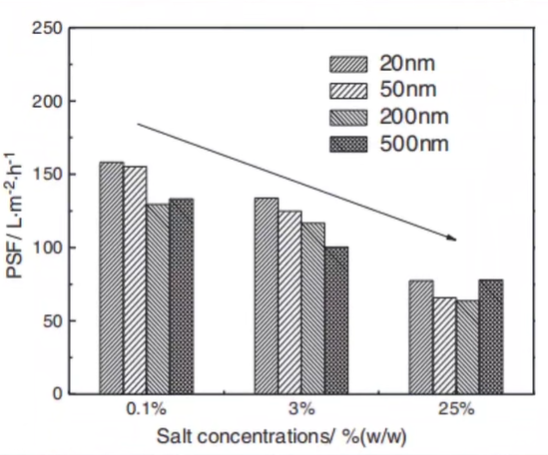
Figure - Effect of inorganic salt concentration on flux decline of PAM-contaminated ceramic membranes
Source: "Application of ceramic membranes in the treatment of oilfield-produced water: Effects of polyacrylamide and inorganic salts"
II. Advantages of Silicon Carbide Ceramic Films in Adapting to Various Scenarios
Previously, we introduced the application of silicon carbide ceramic membrane combination technology in oilfield reinjection water systems [Learn more]. For the characteristics of produced water with high salinity and polymer content, silicon carbide ceramic membranes offer superior adaptability to various operating conditions compared to ordinary inorganic membranes.
● Strong corrosion resistance: Excellent chemical stability, can withstand a wide pH range and high salt corrosion environment, and has no risk of material corrosion damage during long-term operation in complex water quality, making it suitable for harsh working conditions in oil fields.
● The repair methods are comprehensive: routine maintenance can use 60℃ hot alkaline solution in combination with EDTA circulation cleaning to decompose PAM gel and chelate scale ions, which can restore 90% of the flux; in case of severe fouling, it can be regenerated by high-temperature calcination to completely decompose the solidified PAM in the membrane pores, restore the performance of the membrane element, and extend its lifespan.
It is important to clarify that cleaning and regeneration are both remedial measures. Optimizing the pretreatment process and reducing the PAM load on the water are the fundamental ways to ensure the long-term stable operation of the system.
Summary
The fundamental challenge in operating inorganic membranes for oilfield produced water lies in the persistent, deep-seated fouling caused by dissolved hydrolysis of phosphoric acid (PAM). Its negative impact on membrane flux far exceeds that of crude oil and suspended solids, and it synergizes with highly salinized water to form more difficult-to-manage complex fouling. Silicon carbide ceramic membranes, with their strong corrosion resistance and high-temperature regeneration capabilities, are better suited for such complex water quality deep treatment scenarios. However, membrane fouling control still needs to adhere to the principle of "source control as the primary approach, end-of-pipe remediation as a supplement," combining front-end load reduction with standardized operation and maintenance to achieve long-term stable system operation.
● We welcome professionals in the water treatment industry to exchange experiences on membrane fouling control and engineering operation.
● For technical consultation and solution matching regarding silicon carbide ceramic membranes, please feel free to contact us via private message.
● Our company is constantly recruiting for related positions, and we welcome applications from industry professionals.